Opposite of Benefit: Meaning, Examples, Synonyms & Usage Guide
For every perceived benefit in life, there’s often an equally significant opposite. Understanding the “opposite of benefit” is crucial for making informed decisions in both personal and professional realms.
In this article, we’ll dive deep into the meaning, examples, and synonyms related to detrimental outcomes, and provide a practical usage guide. By the end, you’ll be equipped to recognize and articulate these negative facets, enhancing your critical thinking and communication skills.
What Does Benefit Mean?
The term “benefit” can be understood as both a noun and a verb, encapsulating the concept of an advantage or positive outcome that arises from a specific action or decision. As a noun, it often denotes a gain, whether it’s a tangible profit, a favorable result, or even emotional support. For instance, one could discuss the benefits of a healthy diet, which might include increased energy levels and improved overall well-being.
When used as a verb, “to benefit” means to provide an advantage or enhance the situation for someone or something. For example, when a community comes together to support a local initiative, they are benefiting from the improved social cohesion and shared resources.
What Is the Opposite of Benefit?
The most straightforward opposite of benefit is indeed harm. While a benefit enhances well-being or contributes positively to a situation, harm refers to detrimental effects that can result from the same circumstances. For example, whereas a new policy in the workplace might benefit employee morale, its misimplementation could lead to confusion and decreased satisfaction, effectively causing harm.
There are other terms that can serve as opposites depending on the context. Disadvantage is another term that captures situations where the benefits are outweighed by negative factors, leading to less favorable outcomes.
Common Opposites of Benefit
Considering the common opposites of benefit, “harm” stands out as the most straightforward antonym, encapsulating the idea of injury or detriment. It invites us to reflect on the broader implications of our choices, reminding us that our actions might inadvertently hurt others or even ourselves.
In this light, harm serves as a cautionary marker that signals the potential consequences of neglecting ethical considerations.
Another compelling term is “disadvantage,” which points to circumstances that create obstacles or diminish opportunities. This word not only describes unfavorable situations but also encourages a proactive mindset; recognizing disadvantages can propel us to seek solutions and innovations.
Harm as the Main Opposite of Benefit
Harm, in its multifaceted nature, extends beyond the simple negative impact on individuals to encompass broader societal and environmental consequences. For instance, industrial pollution not only endangers human health but also devastates ecosystems, showcasing the interconnectedness of harm across various domains.
This ripple effect emphasizes the importance of considering the broader implications of our actions, urging us to adopt a more holistic perspective when evaluating benefits versus harms.
Difference Between Benefit and Harm
Understanding the difference between benefit and harm is crucial in navigating life’s choices. Benefits often manifest in tangible improvements better health, enhanced relationships, or increased productivity.
For instance, regular exercise not only boosts physical fitness but also elevates mood and cognitive function, illustrating the cascading advantages of positive habits. These outcomes are more than just personal gains; they ripple through communities, fostering a culture of well-being.
Harm can creep in unannounced, often disguised as seemingly innocuous choices. Excessive screen time, for example, may seem harmless at first, but over time, it can lead to diminished attention spans and increased feelings of isolation. Such negative impacts highlight the importance of mindful decision-making.
You May Also Read: FRL Meaning in Text
Benefit vs Disadvantage
When weighing the benefits vs disadvantage of a decision, it’s essential to consider both short-term gains and long-term implications. For instance, while a flexible work schedule may allow for better work-life balance, it can also lead to blurred boundaries between personal and professional life. This tension can sometimes result in burnout, showcasing how a seemingly positive shift can unfold unexpected complications.
Evaluating benefits vs disadvantages invites introspection about personal priorities. The allure of remote work might appeal to one person’s desire for autonomy, while another may feel isolated, truly missing the camaraderie of an office environment.
Benefit vs Loss
When evaluating outcomes in business and personal finance, understanding the dynamic between benefit and loss becomes essential. A benefit often signifies a tangible gain, such as increased revenue or improved quality of life, while a loss can represent not just the depletion of resources but also the potential missed opportunities. In this context, the concept of opportunity cost emerges, highlighting that what we forgo when choosing one path over another can be equally critical to our overall success.
Important Opposite Words List
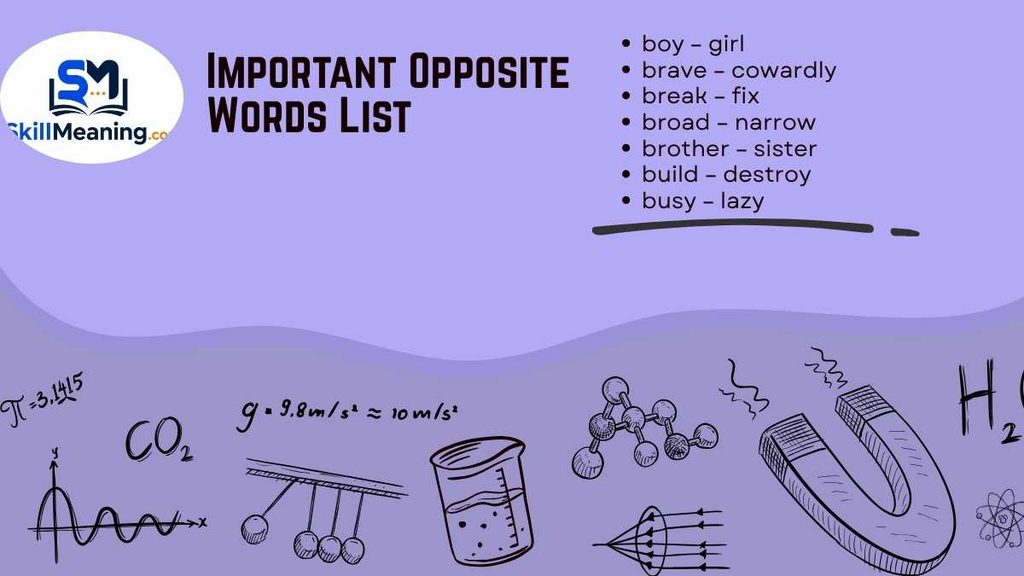
- boy – girl
- brave – cowardly
- break – fix
- broad – narrow
- brother – sister
- build – destroy
- busy – lazy
- buy – sell
- calm – excited
- careful – careless
- careless – careful
- catch – miss
- ceiling – floor
- cellar – attic
- centre – outskirts
- certainly – probably
- changeable – constant
- cheap – expensive
- child – adult
- children – parents
- clean – dirty
- clear – cloudy
- clever – stupid
- close – open
- closed – open
- cloudy – clear
- cold – hot
- cold – heat
- come – go
- comedy – drama
- complicated – simple
- compliment – insult
- compulsory – voluntary
- connect – separate
- consonant – vowel
- constant – changeable
- cry – laugh
- damage – repair
- danger – security
- dangerous – safe
- dark – light
- daughter – son
- dawn – dusk
- day – night
- dead – alive
- death – birth
- deep – shallow
- defeat – victory
- defence – attack
- defend – attack
- delicious – awful
- deny – admit
- depart – arrive
- departure – arrival
- descendant – ancestor
- descent – ascent
- desperate – hopeful
- destroy – build
- destruction – construction
- devil – angel
- dictatorship – republic
- die – live
- emigrate – immigrate
- emigration – immigration
- empty – full
- end – begin
- end – beginning
- ending – beginning
- enemy – friend
- enjoy – hate
- enter – leave
- entrance – exit
- equal – different
- even – odd
- evening – morning
- everybody – nobody
- everything – nothing
Benefit vs Damage
In the intricate dance of benefit vs damage, the choices we make often dictate the trajectory of our lives. For instance, investing time in personal growth such as pursuing education or nurturing relationships cultivates benefits that enrich emotional well-being and enhance future opportunities. Conversely, choices rooted in neglect or procrastination can lead to significant damage, manifesting as lost potential or strained connections. This stark dichotomy illuminates the profound impact our decisions have on both our current state and prospects.
Examples of Opposite of Benefit in Sentences
Examples make understanding easier. Consider these sentences:
- Exercise provides benefits to overall health.
- Smoking causes harm to the lungs.
- Good education benefits society.
- Crime creates disadvantages for communities.
- Careful planning brings benefits.
- Poor decisions may result in losses.
Synonyms of Benefit
Exploring the synonyms of “benefit” unveils a tapestry of meanings that can add depth to our expressions. For instance, the term “advantage” often emphasizes a competitive edge, highlighting how one can leverage opportunities in various contexts, be it in business or personal growth.
On the other hand, “gain” suggests a more tangible outcome, emphasizing measurable results that can be seen and celebrated, whether in financial success or personal achievements.
Read Also: KMG Meaning in Text
Synonyms of Harm
Exploring the synonyms of harm unveils an intricate tapestry of language that can enhance our understanding of negative impact. Words like “damage” often conjure up images of physical destruction, while “injury” may evoke thoughts of personal suffering or trauma. Each synonym carries its unique connotation, allowing writers to express nuances that resonate with their audience.
Why Learning Opposites Improves Vocabulary
Learning opposites, or antonyms, significantly enhances vocabulary by deepening our understanding of word relationships. When we grasp how words are connected through their meanings, it creates a clearer mental map of the language.
For instance, knowing the relationship between “hot” and “cold” allows learners to better understand and remember the words themselves. This contextual understanding not only aids in memorization but also boosts fluency, making it easier for individuals to use these words accurately in conversation.
Opposite of Benefit in Academic Writing
In academic writing, clarity is paramount, and understanding the opposite of benefit plays a crucial role in articulating a comprehensive argument. While “benefit” highlights positive impacts, words like “disadvantage,” “drawback,” or “detriment” serve to underscore the more complex layers of a subject.
By contrasting these terms effectively, writers can create a nuanced view that acknowledges both sides of an issue. This balance not only enhances the depth of analysis but also fosters critical thinking in readers, encouraging them to engage with the text on a deeper level.
Opposite of Benefit in Business Communication
In business communication, grasping the opposite of benefit terms like loss, risk, and disadvantage becomes crucial for a well-rounded strategy. By clearly articulating the potential drawbacks, organizations can prepare for uncertainties that arise in any decision-making process. This proactive approach not only safeguards resources but also fosters a culture of transparency, where employees and stakeholders feel valued and informed.
Discussing risks opens pathways to innovation by encouraging teams to think critically and creatively about solutions. When companies acknowledge potential pitfalls, they demonstrate a commitment to ethical practices and stakeholder interests.
Read Next: 450+ Foods That Start With X
Opposite of Benefit in Everyday Conversations
In everyday conversations, people often overlook how the opposite of benefit harm or detriment plays an equally important role in shaping our narratives. For instance, when someone touts the benefits of exercise for mental clarity and physical health, they may simultaneously hint at the detriments of a sedentary lifestyle.
This juxtaposition not only helps clarify the stakes in a discussion but also emphasizes that choices are interconnected. By recognizing these contrasting elements, speakers can frame their messages more effectively, highlighting both positive and negative outcomes.
How to Choose the Correct Opposite
Choosing the correct opposite indeed hinges on the specific context of the discussion. For instance, in a scenario where you’re addressing an injury, using “harm” captures the negative aspects effectively. It conveys not just physical pain but the broader implications of injury on a person’s well-being.
When discussing unfavorable conditions, “disadvantage” fits well, as it highlights a broader spectrum of challenges that someone might face. In financial discussions, “loss” is a precise term that clearly indicates a diminishment of value or resources.
Common Mistakes When Using Opposites of Benefit
One of the most common mistakes when using opposites of benefit is oversimplifying the relationship by assuming harm is the sole antonym. While harm serves as the clearest opposite, context plays a crucial role in identifying more suitable alternatives.
For instance, when discussing financial implications, “loss” may resonate more profoundly than harm, painting a picture of opportunity missed rather than simply emphasizing injury. This nuanced understanding can elevate discussions and lead to clearer communication.
Importance of Understanding Opposites
The importance of understanding opposites extends far beyond mere vocabulary enhancement; it enriches our ability to communicate complex ideas with clarity. For instance, grasping the contrast between words like “success” and “failure” not only allows us to articulate outcomes more effectively but also encourages critical thinking.
These dichotomies deepens comprehension, enabling individuals to navigate nuances in discussions and arguments, ultimately fostering a richer understanding of thoughts and perspectives.
Read More: IFYKYK Meaning in Text
Conclusion
Understanding the concept of “opposite of benefit” is essential in a variety of contexts, from personal decision-making to business strategies. By exploring terms such as “detriment” and “drawback,” as well as providing relevant examples, we can gain clarity on how negative outcomes can shape our choices.
The implications of these opposites can empower us to approach situations with more nuance and prepare for potential pitfalls. Moreover, utilizing synonyms effectively can enhance communication, helping to convey ideas more precisely. As you move forward, consider how the notion of detriment can inform your own decisions and discussions.
FAQs
What is the opposite of benefit?
The opposite of benefit is “detriment,” referring to something that causes harm or disadvantage.
Can you provide examples of detriments?
Examples of detriments include financial loss, poor health, and negative social impact.
What are some synonyms for detriment?
Synonyms for detriment include harm, disadvantage, damage, and injury.
How is ‘detriment’ used in a sentence?
You might say, “The new policy may lead to a detriment for small businesses.”
Are there other words that convey the opposite of benefit?
Yes, other words include drawback, loss, and liability.