Vicious vs Viscous: What’s the Difference? Meaning, Examples & Common Mistakes Explained
Using “vicious” instead of “viscous” can completely change the meaning of your sentence. It’s a common mistake that many make, but understanding the difference is crucial for effective communication.
In this article, we’ll dissect the terms vicious vs viscous, offering clear definitions, practical examples, and tips to avoid common errors. By the end, you’ll confidently navigate these tricky words and enhance your linguistic prowess.
What Does Vicious Mean?
The term “vicious” primarily refers to a disposition or action that is cruel, brutal, or intentionally harmful. When describing behavior, it often indicates a level of aggression or malice, whether in the form of physical violence, harsh words, or pervasive attitudes that inflict harm on others.
“Vicious” can be used in broader contexts, such as a “vicious cycle,” where negative behaviors or outcomes perpetuate each other, creating a self-reinforcing loop. This multifaceted usage underscores the severity and detrimental nature of the actions or situations being described, emphasizing their potential to cause significant harm.
What Does Viscous Mean?
Viscous describes a substance that has a thick, sticky consistency, which makes it resistant to flow. When we think of viscous materials, common examples include honey, molasses, and certain oils. These substances are much thicker than water and do not pour or spread as easily, which is why they exhibit a slow movement when tilted or stirred.
Viscosity is a measure of a fluid’s internal friction, influencing how it behaves when force is applied. A higher viscosity means the fluid is thicker and flows more slowly, while a lower viscosity indicates a thinner fluid that moves more freely.
Why Do People Confuse Vicious vs Viscous?
People often confuse “vicious” and “viscous” due to their similar spellings and pronunciations, which can lead to misunderstandings, especially among non-native English speakers. “Vicious” refers to something that is deliberately cruel or violent, while “viscous” describes a thick, sticky consistency, like that of honey or molasses. This overlap in phonetics creates a fertile ground for errors in both spoken and written communication.
The increasing reliance on auto-correct and spellcheck features in digital writing can exacerbate the issue. These tools might not always recognize the context or intended meaning, leading to substitutions that reinforce the confusion.
Vicious vs Viscous in Real-Life Contexts
Understanding the distinction between “Vicious vs Viscous” in real-life contexts can illuminate both our emotional experiences and the physical world around us. When we describe a conversation as “vicious,” we tap into a spectrum of human conflict immediate and intense, rife with cruelty or uncontrolled anger. Imagine a heated debate spiraling into a vicious argument, where words cut deeper than any physical confrontation.
On the other hand, “viscous” invites us to contemplate the tangible. Think of honey slowly dripping from a spoon, its thickness creating a sensory experience that can evoke feelings of comfort and warmth. In nature, viscous lava flows shape landscapes, symbolizing both destruction and renewal.
Vicious in Literature and Media
Vicious in literature and media serves as a powerful tool to explore the darker aspects of human nature. Antagonists, often portrayed with multifaceted viciousness, provide a stark contrast to protagonists, creating rich narrative tensions that resonate with audiences.
This duality not only amplifies conflict but also invites readers to reflect on moral complexities, challenging their own perceptions of right and wrong. Characters like Iago in Shakespeare’s *Othello* or the ruthless Heath Ledger’s Joker reveal how deeply ingrained vicious traits can manipulate plot trajectories and evoke empathy, even for the most morally corrupt individuals.
Read Next: Cart vs Kart: Complete Guide With Meaning, Differences, Examples & Correct Usage
Viscous in Scientific Papers and Cookbooks
In scientific papers, the term *viscous* serves as a pivotal descriptor, encapsulating the nuances of fluid behavior that are essential for experimentation and application. For instance, the viscosity of a liquid can dictate how it flows in different environments, influencing outcomes in research and development across diverse fields like materials science and biomedicine.
This precision not only facilitates clearer communication among researchers but also aids in replicating experiments, where understanding the viscous characteristics of a fluid is crucial for consistency and reliability.
Real-World Practical Examples
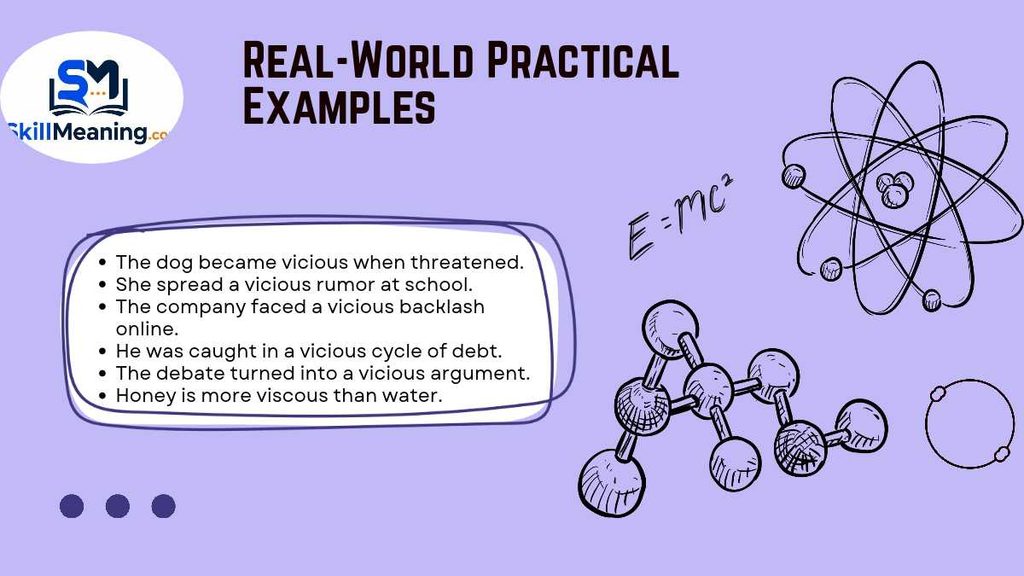
Vicious Examples
- The dog became vicious when threatened.
- She spread a vicious rumor at school.
- The company faced a vicious backlash online.
- He was caught in a vicious cycle of debt.
- The debate turned into a vicious argument.
Viscous Examples
- Honey is more viscous than water.
- The oil became viscous in cold weather.
- This chemical mixture is highly viscous.
- The sauce is too viscous to pour quickly.
- Lava is extremely viscous as it cools.
Can Vicious vs Viscous Ever Be Interchangeable?
Vicious and viscous are indeed not interchangeable, as they convey distinct meanings and are used in different contexts. “Vicious” is an adjective that describes something characterized by cruelty, malice, or morally reprehensible behavior.
It often relates to actions that cause harm or suffering, making it relevant in discussions surrounding ethics or psychology. For example, a “vicious attack” implies a brutal and intentional aggression, showcasing the negative connotations associated with the term.
“Viscous” refers to a physical property of a substance, describing how thick or sticky a liquid is. It is a term commonly used in scientific contexts, such as chemistry or physics, to discuss the behavior of fluids. For instance, a liquid with high viscosity, like honey, flows slowly compared to a less viscous liquid like water.
Synonyms and Alternatives of Vicious
- Cruel
- Brutal
- Savage
- Ferocious
- Malicious
- Violent
- Ruthless
- Hostile
- Aggressive
- Mean-spirited
- Nasty
- Merciless
- Barbaric
- Fierce
- Spiteful
Synonyms and Alternatives of Viscous
- Thick
- Sticky
- Syrupy
- Gummy
- Gluey
- Dense
- Slimy
- Gel-like
- Oily
- Molten
- Semi-fluid
- Heavy
- Sludgy
- Goopy
- Treacly
Read Also: LGHT Meaning in Text
Self-Assessment (Fill in the Blanks)
- I will use ______ when referring to aggressive behavior.
- The correct word is ______ because it describes thickness.
- I will use ______ when talking about sticky liquids.
- The correct word is ______ because it means cruel.
- I will use ______ when describing a harmful action.
- The correct word is ______ because it flows slowly.
- I will use ______ when referring to a violent attack.
- The correct word is ______ because it describes texture.
- I will use ______ when describing a thick sauce.
- The correct word is ______ because it relates to behavior.
- I will use ______ when talking about a negative cycle.
- The correct word is ______ because it is used in science.
- I will use ______ when describing a rude comment.
- The correct word is ______ because it describes liquid resistance.
- I will use ______ when referring to cruelty.
- The correct word is ______ because it describes a sticky substance.
- I will use ______ when talking about an aggressive animal.
- The correct word is ______ because it relates to fluid properties.
- I will use ______ when describing harmful intent.
- The correct word is ______ because it means thick and slow-moving.
Answers
- vicious
- viscous
- viscous
- vicious
- vicious
- viscous
- vicious
- viscous
- viscous
- vicious
- vicious
- viscous
- vicious
- viscous
- vicious
- viscous
- vicious
- viscous
- vicious
- viscous
Common Mistakes to Avoid
Often, writers may fall into the trap of relying on their instincts rather than understanding the nuances of these two words. For example, using “vicious” to describe a substance like syrup showcases a fundamental misunderstanding of the term, which is anchored in notions of cruelty or malice.
Instead of illustrating a thick substance, such a descriptor muddies the waters of clarity, leaving readers puzzled about the writer’s intent. Emphasizing this distinction is crucial — creating vivid imagery in writing hinges on precise word choices.
Read More: Orgo Slang: Meaning, Usage, and Relevance in Digital & Professional Spaces
Conclusion
Understanding the distinction between “vicious” and “viscous” is crucial for effective communication. While both terms may sound similar, their meanings diverge significantly — one relating to malice and the other to the physical property of liquids.
By being aware of these differences, we can avoid common mistakes and convey our thoughts more accurately. Remember to double-check your vocabulary to ensure that you’re using each term in the appropriate context. Don’t let similar-sounding words trip you up; practice will help keep these definitions clear in your mind!
FAQs
What does “vicious” mean?
Vicious describes something that is cruel, malicious, or intentionally harmful, often associated with violence.
What does “viscous” refer to?
Viscous pertains to a liquid’s thickness or stickiness, indicating resistance to flow, like honey or syrup.
Can you give an example of “vicious” in a sentence?
The villain in the story was known for his vicious tactics in gaining power.
Can you provide a sentence using “viscous”?
The chef praised the sauce for its rich, viscous texture that clung beautifully to the pasta.
Are “vicious” and “viscous” related words?
No, they have different meanings and origins; “vicious” is related to behavior, while “viscous” is related to the physical properties of liquids.